
Titanium and aluminum connecting rods should not be judged by a beam name alone. I-beam, H-beam, X-beam, blade-style and other optimized sections are design routes. The final choice depends on material density, stiffness, fatigue behavior, section volume, fasteners, machining method, inspection and the real engine application.
In many performance discussions, steel connecting rods are compared by beam style: H-beam, I-beam or X-beam. When the material changes to titanium or aluminum, the question becomes more complicated. A lightweight material is not simply a steel rod copied in another material.
That is why many titanium and aluminum rod discussions involve I-beam, blade-style or optimized cross-sections. But this should not be simplified into “I-beam is always better” or “H-beam is wrong.” The useful question is: which complete rod design matches the engine?
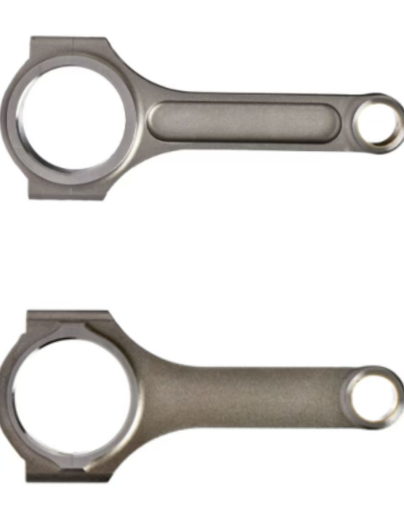
1. Why lightweight materials change the design problem
Steel, titanium and aluminum behave differently. They have different density, stiffness, fatigue characteristics, machining behavior and section-volume requirements. This means a connecting rod designer cannot evaluate only the name of the beam shape.
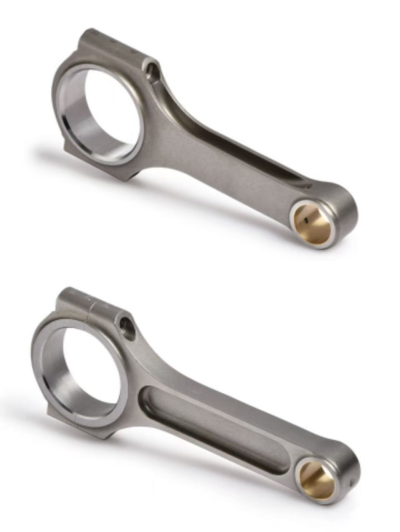
| Material route | Design implication |
|---|---|
| Steel rods | Commonly evaluated by material grade, heat treatment, beam shape, big-end stability and rod-bolt system. |
| Titanium rods | Often selected for weight reduction, but contact surfaces, bolt seating, fretting, stiffness and fatigue behavior require careful design. |
| Aluminum rods | Often used where low reciprocating mass is important, but the lower stiffness route may require more section volume and application-specific service expectations. |
| Optimized section | I-beam, blade-style, single-rib, X-beam or hybrid shapes may be used to balance mass, stiffness, packaging and manufacturability. |
2. Is this really about I-beam versus H-beam?
No. The beam label is a simplified market language. It helps people discuss the rod shank, but it does not fully define the rod.
Public information from established performance brands shows that beam shape is usually discussed together with material, heat treatment, fasteners, dimensions and application. For example, one major Japanese performance brand lists an I-beam connecting rod together with material, heat-treatment, bolt and tightening information. Another major brand explains H-beam selection in relation to weight, buckling strength, production cost and engine purpose.
These sources support the engineering logic that beam shape is not a universal ranking. They do not prove any specific JA-Modified product claim. JA-specific claims must still be confirmed by JA drawings, material records, heat-treatment records, bolt specifications and inspection data.
3. What should B2B buyers actually ask?
For distributors, engine builders, workshops and procurement teams, the most useful question is not “Which beam is strongest?” A better inquiry helps both sides confirm the complete system.
| Buyer-side information | Why it matters |
|---|---|
| Engine code, sample or drawing | Confirms center-to-center length, big-end bore, small-end bore, widths and packaging space. |
| Target use | Street, drag, circuit, endurance, motorcycle, diesel or special-use projects may need different design margins. |
| Performance target | RPM, boost, fuel, piston weight and wrist-pin details affect the rod requirement. |
| Material preference | 4340, 300M, Ti-6Al-4V Grade 5 or aluminum should be selected with the application, not by material name alone. |
| Inspection requirement | Material certificate, hardness, dimensional report, weight matching, MPI or other documents can be planned before order confirmation. |
| Order and packaging plan | Trial quantity, batch quantity, branding and delivery target affect MOQ, lead time and packaging route. |
4. Public-safe conclusion
For lightweight connecting rods, the right design is not decided by “I-beam” or “H-beam” alone. The reliable approach is to match material, section design, bolt system, machining process, inspection and engine application as one system.
FAQ
Are titanium and aluminum rods always I-beam?
No. I-beam, blade-style and optimized sections are common discussion routes for lightweight rods, but they are not universal rules. Different manufacturers may use different section strategies.
Is H-beam wrong for lightweight materials?
No. H-beam is not automatically wrong. The complete geometry, material condition, fasteners and application determine whether a design is suitable.
Can beam shape decide horsepower capacity?
No. Horsepower or RPM capacity cannot be decided by beam name alone. It requires a specific rod design, engine application and validation boundary.
What should a buyer provide before quotation?
Provide the engine code, sample or drawing, target use, RPM / boost / fuel information, piston and wrist-pin details, material preference, inspection requirement, trial quantity and packaging preference.
Technical reference basis
- HKS 4B11 connecting rod product information: HKS product page.
- Tomei 4B11 H-beam connecting rod technical page: Tomei technical page.
- GRP Connecting Rods public company/product information: GRP official website.
- Pauter connecting rod information: Pauter official website.
Related JA-Modified guides
- H-Beam, I-Beam or X-Beam: What Does Connecting Rod Beam Shape Really Change?
- Connecting Rod Materials: 4340, 300M, Ti-6Al-4V Grade 5 or Aluminum?
- Forged Connecting Rod Selection: Why Material and Beam Style Are Not Enough
| Product focus | Forged connecting rods, forged pistons, piston pins, DCT clutch systems and custom engine internal components. |
| Connecting rod materials | Forged 4340 steel, forged 300M steel, Ti-6Al-4V Grade 5 titanium and project-based material options. |
| Project support | Drawing / sample review, material and beam-style discussion, MOQ direction, lead-time expectation, inspection-document scope and packaging plan. |
| Website | www.forgedpiston.biz |
| avon@forgedpiston.biz |
Technical information is provided for selection discussion. Final material grade, product form, heat-treatment condition, dimensions, fasteners, MOQ, lead time and application suitability must be confirmed against the project specification before production or installation.