An OEM piston sample can be the starting point for custom piston development, but it cannot define the final design of a high-compression piston by itself. A custom piston is part of the combustion geometry, not just a copied part.
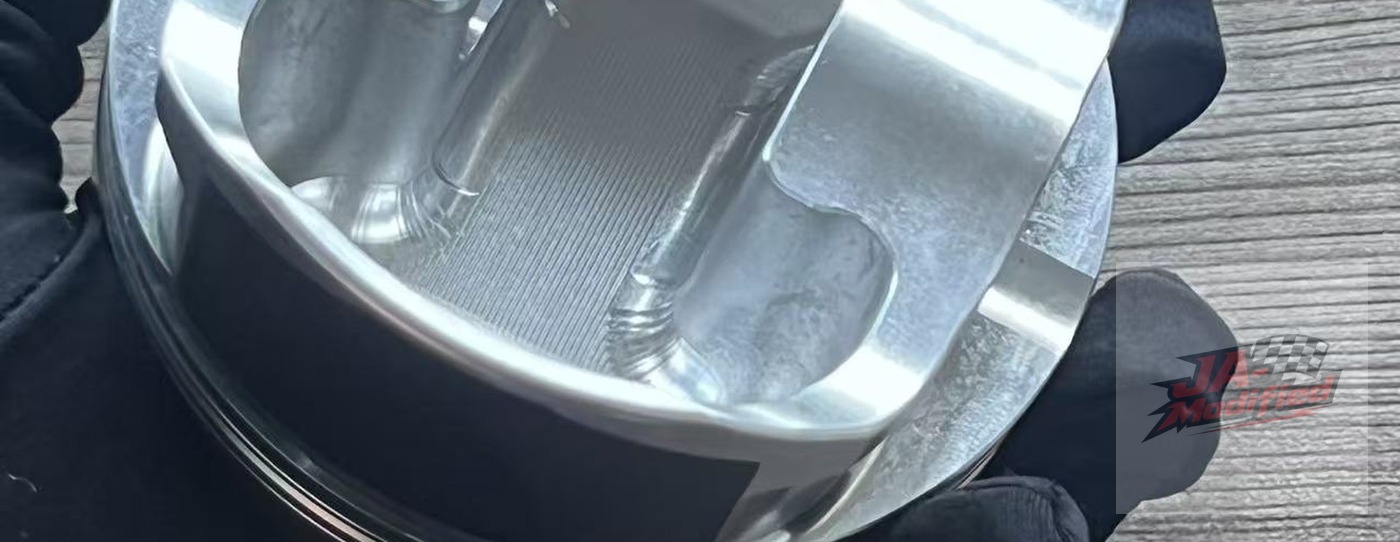
For a naturally aspirated engine, increasing compression ratio usually changes piston crown volume, remaining combustion volume and the clearance space around the piston crown. The design should be evaluated together with bore, stroke, rod length, deck clearance, head gasket, combustion chamber volume, valve motion, spark plug or injector position, and piston weight target.
If the crown is modified based only on a sample, the risk is not just machining difficulty. The final compression ratio may miss the target, or the piston may interfere with valves, chamber edge, spark plug or injector in the real engine.
1. Compression ratio is not decided by the piston alone
Compression ratio describes the relationship between swept volume and the remaining volume above the piston at top dead center.
The piston crown is only one part of that volume. Combustion chamber volume, dome or dish volume, gasket volume, deck clearance, bore and stroke all affect the result.
That is why a high-compression piston should not be understood as simply “making the crown taller.” Crown height, crown volume, chamber shape and valve clearance change together.
2. Key design variables
3. Boundaries of different design routes
Copying from an OEM piston
This can work for replacement-style geometry. It helps match basic dimensions, pin bore, ring grooves, skirt profile and installation relationship. But it does not automatically complete a high-compression design.
Increasing compression ratio from the OEM baseline
This requires crown volume calculation and clearance review around the valves, spark plug, injector and chamber edge. It is more complex than simple copying because the remaining combustion volume is changed.
Increasing compression ratio while controlling weight
This requires balance between crown volume, valve pockets, pin boss, skirt profile and ring groove safety margin. It should not be advertised as “always lighter, stronger or more durable.” The final decision depends on the actual engine and design constraints.
4. Public technical basis
Public technical materials from performance piston manufacturers commonly define custom pistons through engine geometry, not by a sample alone.
Verifiable public references show that compression ratio calculation involves bore, stroke, combustion chamber volume, piston dome/dish volume, gasket volume and deck clearance. CP-Carrillo’s custom piston order form includes fields such as bore, stroke, pin diameter, head cc, compression ratio, block height, gasket thickness, deck clearance, intake/exhaust valve, valve lift, usage, horsepower and RPM.
These references support the engineering logic that a custom piston should be defined through the engine package. They do not prove any universal horsepower, RPM, service life or fitment guarantee for a specific piston. Final specifications must be validated against the actual engine and drawing.
5. JAMODIFY technical view
JAMODIFY does not look at custom pistons only from the machining side. We look at whether the piston can work safely inside the actual engine package.
A proper high-compression custom piston should balance target compression ratio, crown volume, valve clearance, structural strength, weight control and the real engine configuration. When data is incomplete, a preliminary review is possible, but it should not be presented as a final guarantee.
FAQ
Can an OEM piston sample be used directly for custom piston design?
It can be used as a starting reference, but not as the only design basis for a high-compression piston. Compression ratio and interference risk depend on the full engine geometry.
Is increasing compression ratio the same as making the crown taller?
No. Increasing compression ratio means changing the remaining volume above the piston at top dead center. Crown shape is only one variable.
Why do high-compression pistons need valve relief review?
Because the piston and valves may occupy a very tight space around top dead center. Valve diameter, angle, lift and cam timing all affect the clearance boundary.
Can a piston be higher-compression and lighter at the same time?
Sometimes, but not always. Weight reduction must be balanced with crown strength, pin boss support, skirt stability and ring groove safety margin.
Can design start without combustion chamber volume?
An initial review can start, but the final compression ratio and clearance should be confirmed with more complete engine geometry or sample fitting verification.
Technical reference basis
- CP-Carrillo Custom Piston Order Form PDF: PistonCustomOrderForm17.pdf.
- CP-Carrillo Custom Piston Order Form page: custom piston order form.
- JE Pistons compression ratio article: compression ratio and displacement.
- JE Pistons custom piston order form: custom piston order form.
- Diamond Pistons custom piston order form: custom piston order form.
Related JA-Modified guides
- Forged Piston & Connecting Rod Installation Guide
- Can a Piston Crown Be Re-Machined After Interference?
- DLC Wrist Pins, 2618 and 4032 Forged Pistons
| Technical focus | Forged pistons, piston pins, connecting rods, DCT clutch systems and custom engine internal components. |
| Website | www.forgedpiston.biz |
| avon@forgedpiston.biz |
Technical information is provided for engineering discussion. Final piston dimensions, compression ratio, clearance, material, coating, weight target and application suitability must be confirmed against the actual engine specification before production or installation.