
That tiny pin on a 2-stroke piston what is it? Why do some engines have its pins spaced far apart while others place them almost together? And what makes the KTM 300 so special?
This JA-Modified technical analysis starts from first principles to fully break down the function, design logic, and engineering trade-offs behind the 2-stroke piston locating pin, with a deep dive into the KTM 300's unique approach.
If the piston rings are a 2-stroke engine's first line of defense, the locating pin is its sentry. At JA-Modified, we've seen engines seized simply because a ring rotated into a port and caught the edge. When the locating pin fails, the engine can seize in minutes.
1. What Does the Locating Pin Do?
1.1 Why Stop Ring Rotation?
A 2-stroke cylinder wall is filled with scavenge and exhaust ports. These openings are essential for gas flow, but for the piston rings, they are traps.
| If the ring can rotate freely¦ | Consequence |
|---|---|
| Ring gap rotates into a port opening | Ring catches the port edge during motion |
| Continued motion after catching | Ring breaks or scored cylinder wall (seizure) |
1.2 How the Locating Pin Works
A small pin is pressed into the piston ring groove. It engages with the ring gap, locking the ring's rotational position. JA-Modified machines precision locating pin grooves into every custom forged piston, with clocking positions verified per application to ensure optimal sealing regardless of cylinder geometry.
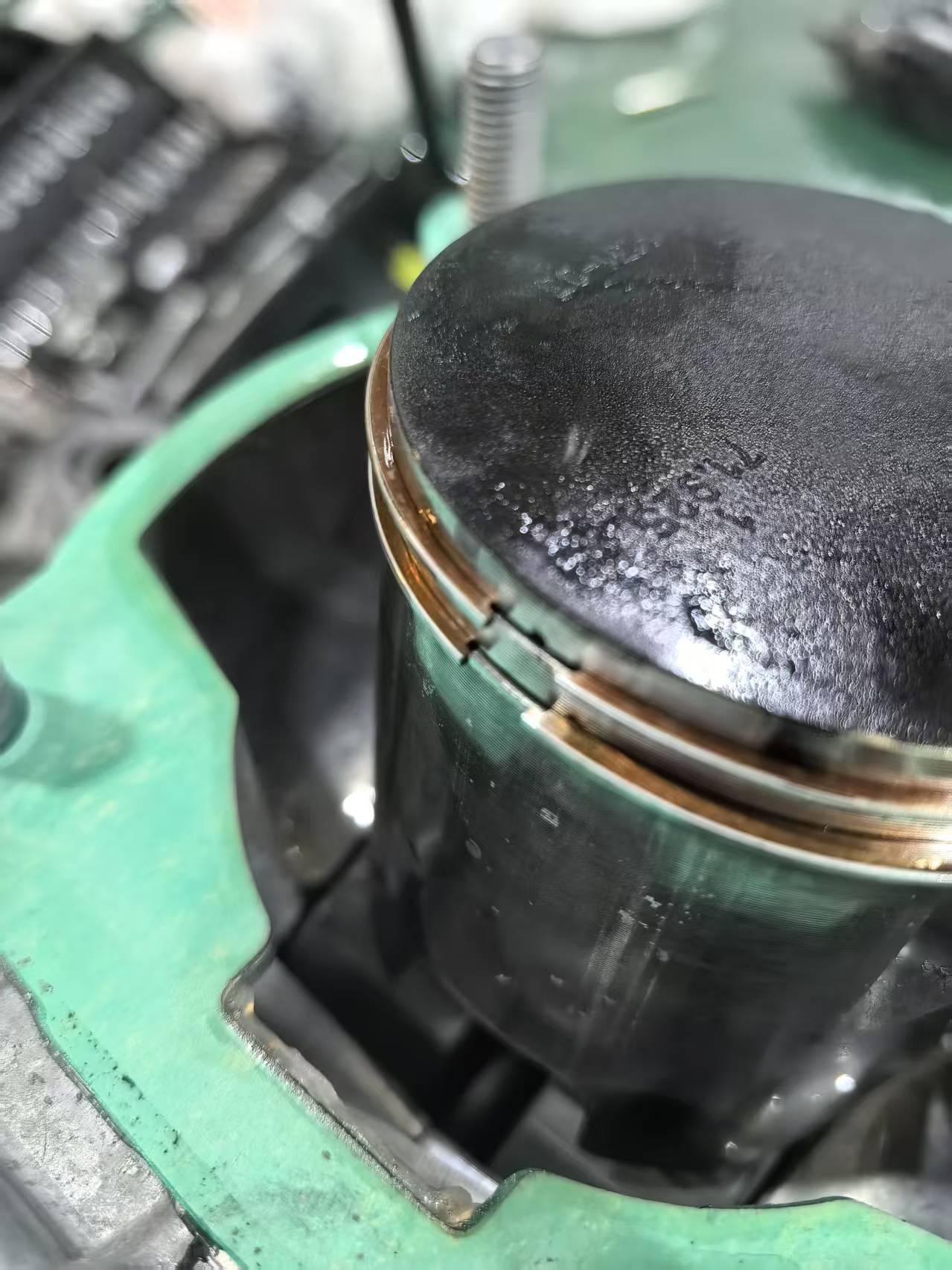
One-sentence principle: Prevent the ring gap from rotating into a port opening.
1.3 Two Pin Positions
| Type | Position | Notes |
|---|---|---|
| Center Pin | Pin in the middle of the groove | Mainstream KTM OEM, Japanese, Taiwanese, Chinese all use this |
| Offset Pin | Pin near the side of the groove | Rare special designs; KTM 300 does not use this |
2. Why Must the Two Ring Gaps Be Offset?
A 2-stroke piston typically has two rings: one compression ring and one oil/scraper ring. The locating pins fix each ring's gap position, which raises the second core question: what relative angle should the two gaps be at?
2.1 The Gas Leakage Path
| Layout | Gas Path | Result |
|---|---|---|
| Gaps aligned (straight line) | Gap 1 passes straight through Gap 2 | Direct blow-by |
| Gaps offset | Gap 1 blocked by Ring 2 body | Effective seal |
Ring 1 ® Gap
Ring Ring Ring 1 (Compression)
Ring Ring Ring 2 (Scraper)
Ring 2 ¯ Gap
Aligned: gas blows straight through
Offset: labyrinth seal
"If the two pins are vertically aligned, you will get 100% blow-by. They must be offset." Veteran piston supplier
2.2 Core Principle
Two-ring design is fundamentally a labyrinth seal: gas that escapes the first ring is caught by the second. Aligning the gaps is like opening a straight channel through the labyrinth it renders both rings useless. JA-Modified always verifies pin offset angles during the design phase to ensure proper labyrinth sealing for every custom piston application.
3. What Makes KTM 300 Special?
3.1 Normal Motorcycle Design
A typical motorcycle cylinder has limited ports, leaving ample solid wall area for pin placement:
¬¬ Port Solid Wall Solid Wall ¤ Port ´´ Plenty of solid wall area for pin placement
| Feature | Normal Motorcycle |
|---|---|
| Number of ports | Limited, 2~4 |
| Solid wall area | Ample |
| Two-pin offset angle | 90Â ~ 180Â |
| Ring sliding over ports? | Not needed |
3.2 KTM 300's Dilemma
The KTM 300 is a competition enduro bike with one design goal: maximum power. JA-Modified frequently analyzes competitive engine platforms and has documented this pattern across multiple high-performance 2-stroke applications. To achieve this, engineers made the scavenge and exhaust ports large and numerous. The result: solid wall area became extremely narrow.

KTM 300 cylinder wall (conceptual):
¬¬¬¬¬¬¬¬
P P P P P
´´´´´´´´
Lands are extremely narrow (width depends on specific cylinder geometry)
| Comparison | Normal Motorcycle | KTM 300 |
|---|---|---|
| Design goal | Balanced | Extreme power |
| Number of ports | Few | Many |
| Solid wall area | Ample | Almost none |
| Available land width | Relatively wide | Extremely narrow |
| Possible pin offset | 90Â ~ 180Â | Just a few mm |
3.3 Two Options, Two Risks

JA-Modified evaluates these trade-offs on every custom piston project, ensuring the pin placement and ring specification are optimized for the specific cylinder geometry rather than applying a one-size-fits-all solution.
| Option | Approach | Risk |
|---|---|---|
| A (KTM's choice) | Pins in the middle of the ports, retaining minimum offset | Rings slide over ports; port edge must be deburred (sandpaper finishing) sealing relies on ring precision |
| B (Theoretically better) | Force pins onto the narrow lands for wide offset | Cylinder casting tolerances + pin hole perpendicularity deviation pin grinds against port edges more likely to fail |

"If the casting is slightly off the port shifts a bit, or the pin hole is drilled at a slight angle it will grind against the edge and fail even faster." Piston ring manufacturer, decades of experience
3.4 The Competition Trade-Off
| Priority | Focus |
|---|---|
| 1st | Maximum power output |
| 2nd | Race-length durability |
| 3rd | Long-term lifespan |
KTM 300's pin design logic:
- Since ports can't be avoided slide stably through the port openings
- Since both pins are near each other place them as close as possible, but retain the minimum necessary offset (a few mm)
- Rely on ring precision to compensate for the positional compromise
When JA-Modified produces pistons for KTM 300 and similar competition platforms, we account for this engineering constraint in the ring groove and pin placement specifications.
3.5 European vs. Japanese Design Philosophy
Not all 2-stroke engines follow the same design approach. European and Japanese manufacturers have fundamentally different philosophies for locating pin placement:
| Design School | Example | Ring Gap Path | Key Requirement |
|---|---|---|---|
| European | KTM | Through a specific port with edge deburring | Port edge must be deburred no burrs, no sharp edges |
| Japanese | Honda | Between ports on cylinder wall (no port contact) | Casting position + pin position must be precise |
Both designs demand extremely high cylinder casting precision but the challenge lies in different areas. European precision is in the port chamfer; Japanese precision is in the casting position and pin location.

4. A Common Misconception
4.1 "The Gaps Are Aligned!"
When people disassemble a KTM 300 piston for the first time, they often exclaim. This is the most common misunderstanding and one that JA-Modified's technical support team fields regularly.
4.2 Key Principle: Rings Rotate Freely When Removed
| State | Can the ring rotate? | Are the gaps aligned? |
|---|---|---|
| Disassembled | Free to rotate by hand | Twist them together they look aligned |
| Installed (working) | Locked by locating pins | Gaps fixed at pin positions pins are offset gaps are offset |
"Once you take the rings off, they spin freely in the groove." Veteran piston supplier
The "alignment" you see during disassembly is simply a visual coincidence it does not represent the working state of the engine. JA-Modified recommends always checking the actual locating pin positions rather than relying on the visual appearance of disassembled rings.
4.3 Another Visual Trap
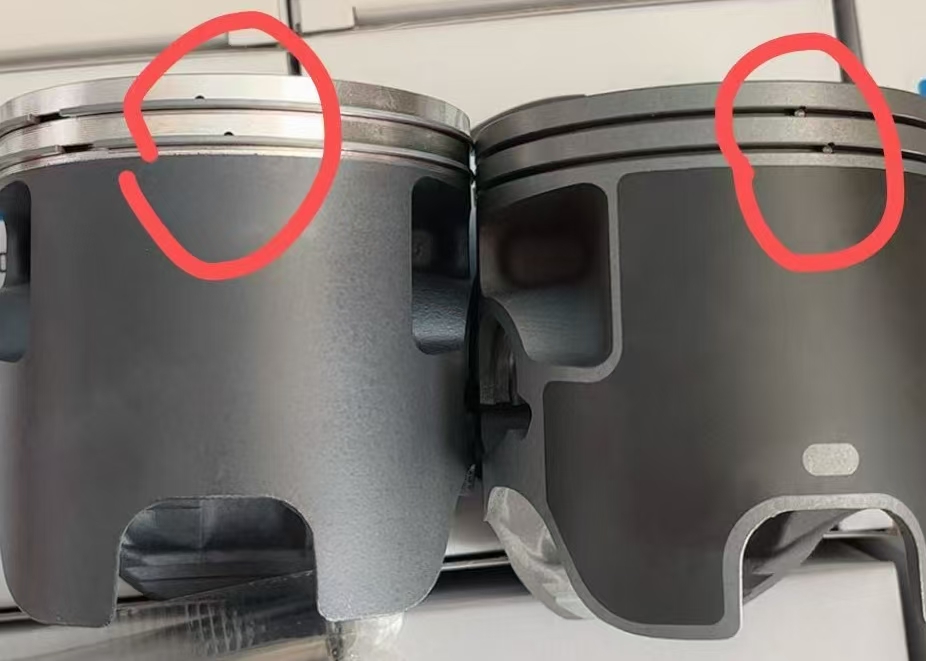
Many people photograph a piston and ask: "There's only one pin?" The answer: the other pin is hidden behind the ring body change your viewing angle and you'll see it. JA-Modified provides detailed technical documentation and photography with every custom piston set to eliminate this confusion.
5. What Actually Determines Sealing Quality?
5.1 Pin Position vs. Ring Quality
The locating pin prevents rotation into ports, but what truly determines sealing and longevity is ring quality a principle JA-Modified applies to every piston we manufacture:
| Key Parameter | Impact |
|---|---|
| Roundness | Poor roundness local blow-by |
| Gap Closure / Ring Lift | Raised end accelerated gap wear blow-by |
| Radial Pressure Uniformity | Uneven pressure localized sealing failure |
| Material Consistency | Poor material early fatigue failure |
5.2 Why KTM 300 Is Especially Sensitive
JA-Modified selects ring suppliers based on measured roundness and material consistency data, not just price because ring quality is what ultimately determines engine sealing performance.
KTM 300's ring gaps slide over port openings, which means:
- Higher stress at the ring gap (no cylinder wall support at the port)
- If the ring end has "lift" the gap edge wears first
- Once worn sealing drops blow-by accelerates vicious cycle
"If your ring has even slight lift at the gap, it won't last. On a KTM, it's especially short-lived."
5.3 The Material Gap
| Source | Ring Material | Machining Precision | Material Consistency |
|---|---|---|---|
| Taiwan | Ductile iron | Meets spec | Average |
| China (domestic) | Ductile iron | Meets spec | Average |
| Japanese top-tier | Ductile iron (better formulation) | Meets spec | Best |
"The machining is similar across all sources. The only real difference is the material. You'll never get Japanese-grade material consistency elsewhere." Piston ring industry veteran
6. Important: EFI vs. Carburetor Piston Differences
When ordering KTM 300 pistons, one of the most common mistakes is confusing EFI (electronic fuel injection) and carburetor versions.
6.1 Why the Difference Exists
EFI engines are calibrated for stricter emissions compliance they deliver less fuel and oil into the combustion chamber. This results in higher operating temperatures and therefore greater thermal expansion of the piston.
To accommodate this, EFI pistons are manufactured with larger piston-to-cylinder clearance than carburetor versions.
6.2 Key Differences at a Glance
| Parameter | EFI | Carburetor |
|---|---|---|
| Nominal size (A type) | 71.925 mm | 71.94 mm |
| Piston-to-cylinder clearance | Larger | Smaller |
| Skirt cutout shape | Smaller opening | Larger opening (rounded) |
| Typical era | 2019+ (import models) | Older / domestic models |
| Emissions compliance | Stricter | Less strict |
6.3 How to Identify
Visually, the difference is subtle you need to place both side by side to see it clearly. The most noticeable distinction is the skirt cutout shape at the bottom of the piston skirt.
6.4 Ordering Guidance
Customers typically do not say "EFI" or "carburetor" they give you a measurement:
- 71.94 mm Carburetor A-type
- 71.925 mm EFI A-type
Before confirming any order, always verify the piston-to-cylinder clearance specification with the customer. Installing the wrong version can lead to:
- Too tight (carb piston in EFI cylinder) piston seizure due to insufficient clearance
- Too loose (EFI piston in carb cylinder) piston slap and accelerated wear
When in doubt, ask for the exact cylinder bore measurement to confirm fitment.
Summary
| # | Key Point | One-Liner |
|---|---|---|
| 1 | Pin function | Locks the ring gap to prevent it from rotating into cylinder ports |
| 2 | Gaps must be offset | Aligned gaps = 100% blow-by |
| 3 | Why KTM 300 is special | Cylinder has too many ports; pins run through port windows with minimum offset a competition-oriented engineering compromise |
Final thought: If you see "aligned ring gaps" when disassembling a piston remember: rings spin freely when removed. It's different once they're installed.
Whether you're building a KTM 300 for competition or a custom 2-stroke project, understanding locating pin design and ring sealing principles is essential for engine reliability. JA-Modified provides engineering support, custom piston manufacturing, and technical documentation for engine builders worldwide.