The oil passage is part of a chain
In a pressure-fed four-stroke design, the intended route may include the oil pump, crankshaft gallery, crank-pin passage, big-end bearing opening, connecting-rod passage and small-end outlet. The exact route varies by engine architecture.
That is why a deep oil passage should be evaluated with the crankshaft, bearing opening, rod orientation, wrist-pin interface and engine architecture. A hole in the rod does not describe the complete oiling system.
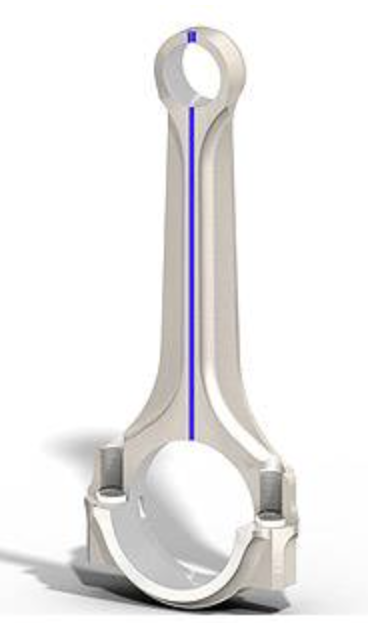
A passage also creates design and manufacturing requirements
Drilling removes material from the rod section and creates entry, exit or intersection features. Local stress behavior can depend on hole geometry, surrounding section, surface condition, fillet transitions, material and load case. Manufacturing quality also matters: burrs, debris, blocked passages or an incorrect outlet can undermine the intended function.
What should be checked before installation?
- Confirm that the engine uses the required pressure-fed oil path.
- Confirm the relationship between the crankshaft passage and the bearing opening.
- Confirm the rod passage and outlet are open, clean and free of harmful burrs.
- Confirm the outlet position matches the small-end or wrist-pin design.
- Confirm the connecting-rod orientation for the specific engine.
These are inspection principles, not universal dimensions. Hole size, clearance and orientation must follow the applicable drawing or installation specification.
JA-Modified technical view
A rifle-drilled rod is neither universally necessary nor universally useless. The engineering question is not “Does this rod have a deep oil hole?” It is “Does the engine, crankshaft, bearing and connecting rod form a complete lubrication path?” Its value depends on system matching and verification.
FAQ
No. It may support lubrication to a target area when the complete oiling path is compatible. It does not replace correct geometry, materials, clearances, assembly or validation.
No. Engine architecture, crankshaft drilling, bearing openings, rod orientation and wrist-pin requirements differ.
No. The passage must be evaluated together with section strength, flow requirements, manufacturing limits and the intended load case.
The inspection logic is consistent with public engine-component failure guidance, including attention to bushing dimensions and oil-hole orientation. This does not prove any JA-Modified product specification. Final geometry, oil routing and installation requirements must be checked against the applicable drawing and validation record.