
What is being judged?
These are related questions, but they are not interchangeable. Manufacturing one sample does not prove performance. Passing one test does not define an untested operating envelope. Several successful parts add evidence, but they do not automatically establish statistical process stability.
The JA-Modified five-layer evidence framework
This is a practical review framework, not a universal certification standard. The evidence plan should be tailored to the component, application, failure consequences and development stage.
Manufacturability
Can the intended material, geometry and manufacturing route produce the part? A successful build or machining operation demonstrates feasibility—not service performance.
Sample conformity
Does the sample meet the applicable drawing, material condition, dimensions, hardness, surface requirements and defect limits?
Controlled functional testing
Were configuration, load spectrum, speed, temperature, pressure, lubrication and cycles defined and recorded? A pass is meaningful only inside a known test boundary.
Post-test evaluation
Where appropriate, dimensional inspection, crack detection, wear measurement and permanent-deformation checks can reveal damage that was not visible during operation.
Repeatability and process evidence
Can additional parts and production runs meet the same requirements? Repeat results increase confidence, while credible measurement, controlled inputs, specification limits and sufficient time-series data are still needed before claiming process stability or capability.
Why bold claims need explicit boundaries
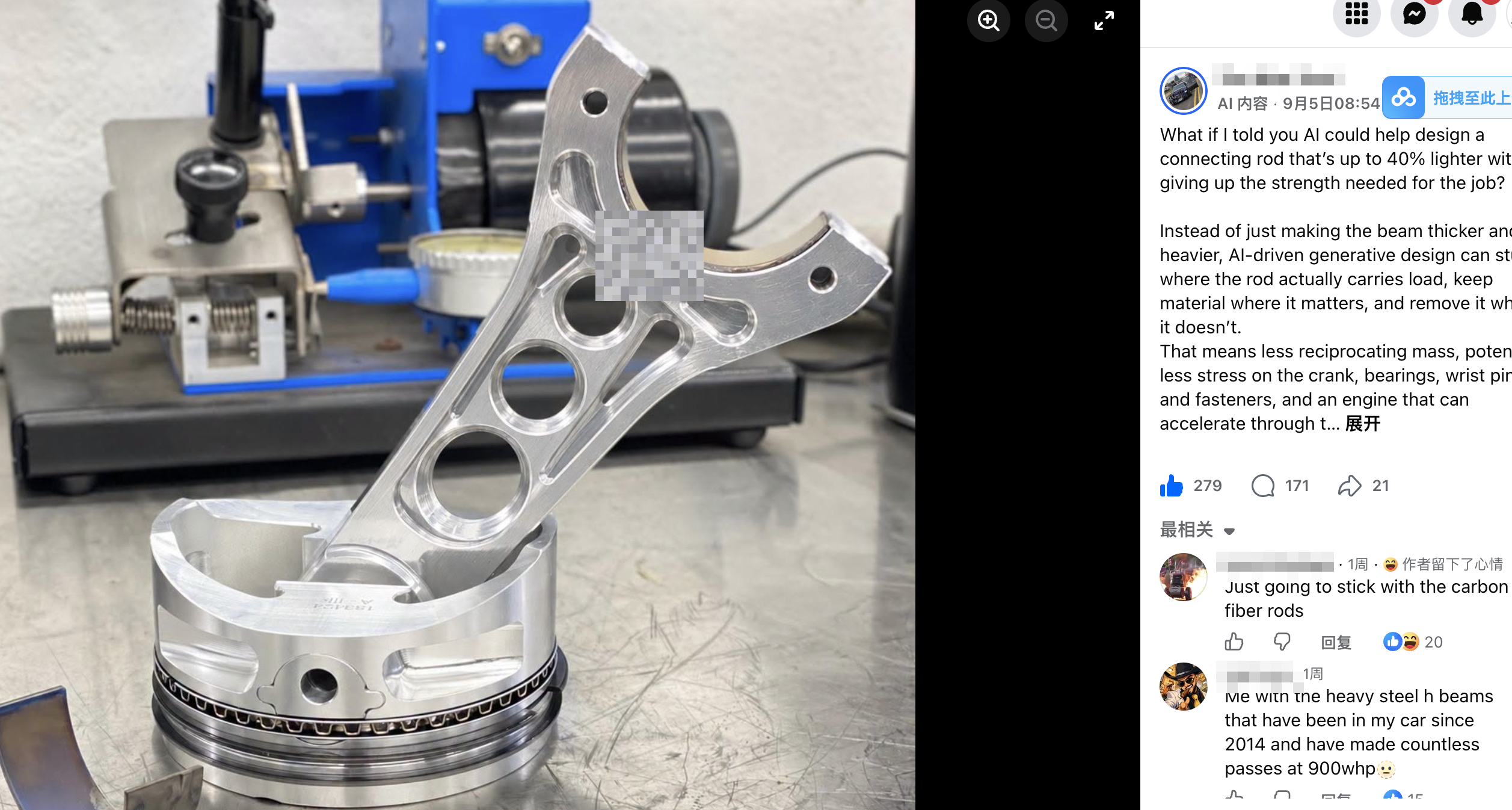
Public posts may describe a 17:1-compression piston intended for a 2,000-hp engine or a generatively designed connecting rod claimed to be up to 40% lighter. Those numbers can be useful prompts for engineering discussion, but without drawings, material condition, manufacturing records, load cases, test data and post-test findings, they remain the poster's claims—not validated performance conclusions.
Can controlled failure testing be useful?
Yes—when it answers a defined engineering question. An ultimate-load or destructive test may help identify a limit, reveal a failure mode and improve correlation between analysis and physical behavior. Simply operating an engine until something breaks may create overlapping damage that obscures the initiating event.
Useful boundary testing normally records component identity, material or batch, drawing and process revision, load history, measured operating conditions, acceptance criteria and post-failure findings. Without traceability, it may be impossible to separate a fastener problem from preload, big-end bore, bearing, lubrication, detonation, overspeed or assembly effects.
Example: evaluating a new connecting-rod bolt
A new bolt source is not automatically unsafe, and an established brand does not remove the need to confirm the exact part number and installation specification. Depending on risk, a validation plan may include material traceability, dimensional and thread inspection, hardness and surface checks, tensile or proof-load testing, torque–preload–stretch repeatability, fatigue evaluation, assembled big-end bore measurement, controlled engine testing and post-test inspection.
The required sequence depends on the bolt, connecting rod, engine configuration and intended duty cycle. No universal torque, stretch or sample count is implied here.
Frequently asked questions
Does one successful dyno pull prove the design?
No. It documents one result under one set of recorded conditions. It may support the next development decision, but it does not independently prove fatigue life or production consistency.
How many successful parts are enough?
There is no universal number. Sample size and test coverage depend on failure risk, expected variation, required confidence, the test method and available prior knowledge.
Do several successful batches prove mass-production stability?
They provide repeatability evidence. Process stability also depends on reliable measurement, controlled inputs, defined specifications and data collected over a suitable period.
Is testing until failure bad engineering?
Not when it is a controlled test with a defined purpose. It becomes weak evidence when the load history, part history and initiating failure mode cannot be reconstructed.
Technical boundary
This article presents a general JA-Modified review framework. It does not claim that every JA-Modified product has completed every test listed above. Product-specific performance claims require the applicable drawing, inspection records and validation evidence.
Technical references
- FAA AC 33.15-3 — Powder Bed Fusion Additive Manufacturing Process for Aircraft Engine Parts. Used here as an example of process qualification, traceability and repeatable-result logic; it is not an automotive certification requirement.
- NASA-STD-6030 — Additive Manufacturing Requirements for Spaceflight Systems. Used as a reference for traceability and controlled AM process evidence; applicability is aerospace-specific.
- NIST Engineering Statistics Handbook — Assessing Process Stability.
- NIST Engineering Statistics Handbook — What Is Process Capability?.
- ARP — Design Procedures for Automotive Bolts, including preload and bolt-stretch discussion.
Sources checked September 15, 2026. External standards are cited for engineering principles and must be applied only within their stated scope.
Developing a piston, connecting rod or fastener for a specific application?
info@forgedpiston.biz · www.forgedpiston.biz
Discuss Your ApplicationNot matched, not delivered.