
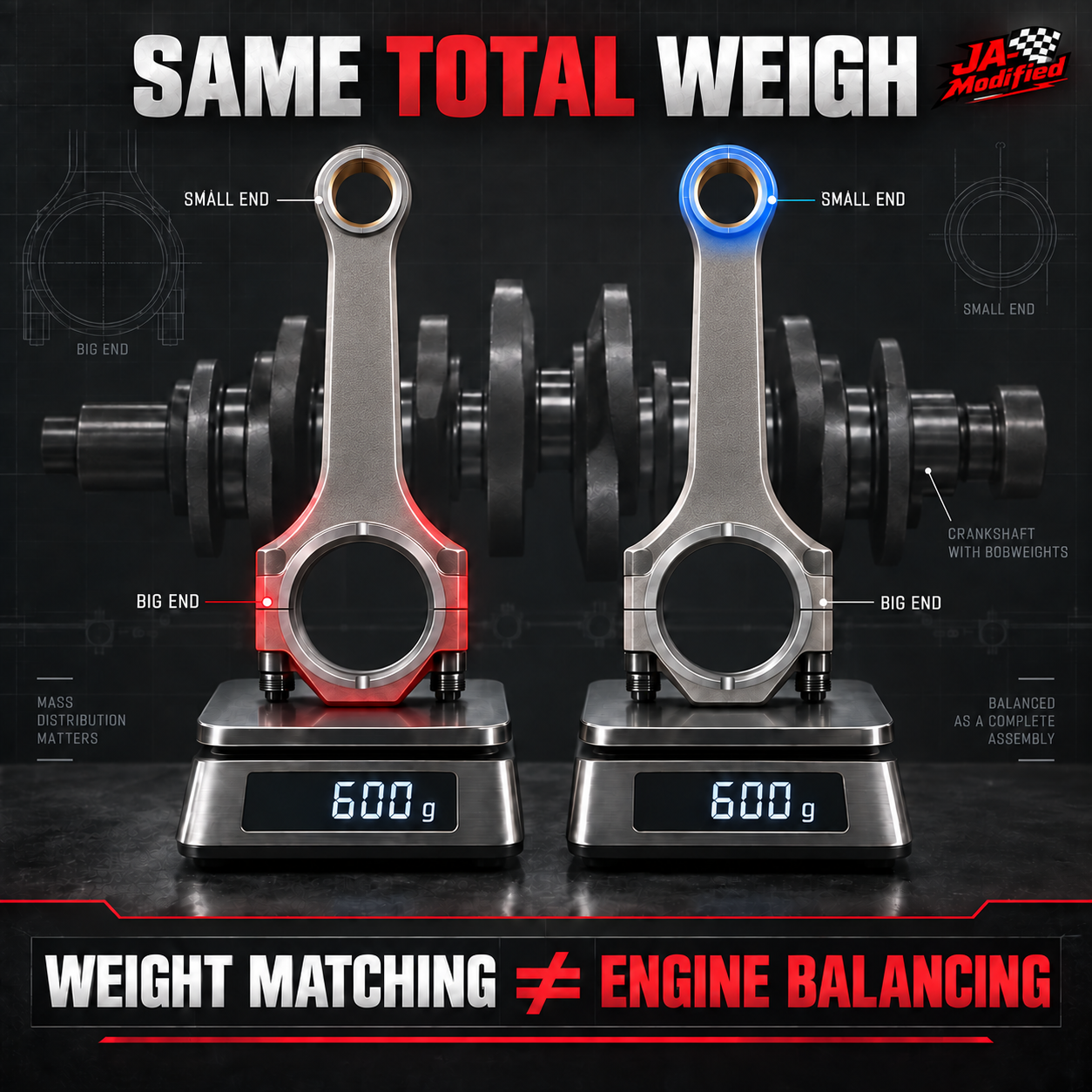
Why total rod weight is not enough
The big end follows the crankpin in rotation, while the small end moves with the piston and changes direction every revolution. Professional bobweight procedures therefore separate big-end weight from small-end weight.
Two rods can have the same total weight but different end-to-end mass distribution. For replacement matching and crankshaft balancing, separated end weights provide more useful information than total weight alone.
What rod-set weight matching controls
Weight matching controls variation within a set. Records may include total weight, big-end weight, small-end weight, maximum set variation, part number, drawing revision and production traceability.
This improves component consistency between cylinders. It does not correct crankshaft imbalance or prove that the assembly matches the intended bobweight.
What crankshaft balancing considers
Where simulated bobweights apply, the balancing calculation can include piston, wrist pin, rings, locks, rod bearing, rod small-end mass and rod big-end mass. Calculated weights are installed on the crank journals while the crankshaft is measured on a balancing machine.
The exact calculation, reciprocating factor, oil allowance and permissible residual imbalance depend on engine architecture, method, equipment and specification. One formula or tolerance should not be presented as universal.
What changes when lighter components are installed
Replacing a piston, pin or rod changes the mass combination. Lower mass can reduce some inertia loads, but lighter does not automatically mean correctly balanced. The new component weights and their distribution should be reviewed against the crankshaft's intended balance condition.
Internal balance and external balance describe where correction is provided. They do not mean a crankshaft is automatically balanced for every piston-and-rod combination.
Can one damaged connecting rod be replaced
A replacement rod should not be selected by total weight alone. Critical dimensions, big-end weight, small-end weight, bolt specification and inspection requirements should match the remaining set. Whether crankshaft balance must be rechecked depends on the actual mass change and applicable specification.
FAQ
No. Matching controls rod-to-rod variation; balancing evaluates the crankshaft for a defined assembly mass condition.
No. Use the applicable drawing and inspection plan.
No. Vibration also depends on crankshaft balance, mass distribution, architecture, stiffness and combustion variation.
That is not a safe general statement. Single-cylinder engines still have rotating and reciprocating inertia forces, but their method should not be copied directly from a multi-cylinder V-engine procedure.
JA-Modified technical position
JA-Modified treats rod weight matching and crankshaft balancing as related but separate controls. Product-specific tolerances and balancing data must come from the applicable drawing, inspection plan or validated engine-builder requirement. We do not apply a universal gram tolerance, fixed big-end percentage or universal balance factor to every engine.
Eagle: Crankshaft Balancing Explained
Eagle: Customer-Supplied Bobweights
Callies: Compstar Speed Packs
MAHLE/Clevite: Bearing Design
These references support general engineering logic, not JA-Modified product-specific tolerances.