ENGINEERING NOTES · MATERIALS & DESIGN
Connecting Rod Beam Design: Balancing Strength and Weight
H-beam, I-beam, X-beam, IQ-beam and T-beam names can start a product discussion. They cannot establish which connecting rod is stronger, lighter or better suited to an engine.
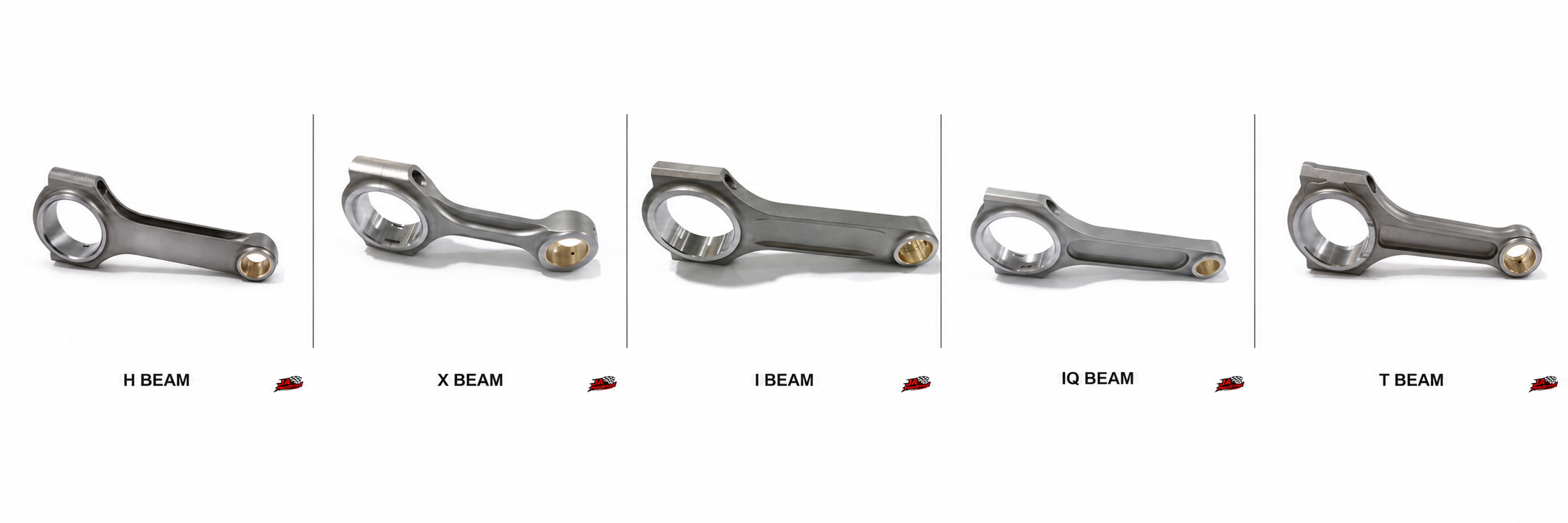
A more useful design objective is to meet the intended operating and service-life requirements while reducing unnecessary mass. Strength, stiffness, durability and weight need to be considered together. The lightest option is not automatically the right option for every application.
JA-Modified beam-shape illustration (AI-generated reference; not a dimensional or strength comparison).
What Manufacturer Examples Actually Show
CP-Carrillo's rod design information describes a tapered H-beam design that reduces reciprocating-end weight. It also describes a stepped H-beam weight-reduction approach for limited cylinder-pressure applications. These examples show that weight reduction is a deliberate design objective with application limits.
CP-Carrillo's custom product information describes using finite element analysis to evaluate strength and weight. This supports considering both in the design process; it does not establish a universally lightest or strongest beam type.
Pauter's connecting rod information explains its own cross-beam approach through stress distribution, transitions and material retained in critical areas. The example supports a practical principle: retain necessary material where the design requires it, and evaluate opportunities to reduce mass elsewhere.
These are manufacturer-specific examples. They are not validation results for JA products or proof that every similarly named beam behaves the same way.
Why the Operating Conditions Matter
CP-Carrillo's connecting rod FAQ identifies engine speed, crank-and-rod geometry, component weights and cylinder pressure as relevant selection factors. Horsepower alone is insufficient.
“Stronger where required, lighter where possible” is therefore a useful design direction when tied to defined operating conditions and validation. “Maximum weight reduction at any cost” is not a supported universal rule.
How to Compare H, I, X, IQ and T Designs
Start with the exact manufacturer and part number. Then request comparable information:
- Dimensions, section geometry and installation clearance.
- Total weight and big-end/small-end weight distribution.
- Intended engine speed, cylinder pressure and service-life requirements.
- Piston weight, stroke and rod length.
- Material, heat treatment and bolt specifications as comparison conditions.
- Relevant analysis and test results, including their load cases and acceptance criteria.
Dimensional and inspection reports can contribute to an assessment, but they should not be presented as a universal strength ranking.
What the Names and Illustration Cannot Tell You
Pauter's cross-beam explanation applies to its own design; it should not be generalized to every X-beam product. Likewise, the IQ-beam and T-beam labels in the illustration do not establish product dimensions, weight, strength or fatigue performance. Product-specific evidence is needed before making those comparisons.
The practical question is: which documented design meets this engine's requirements at an appropriate weight? A beam label or illustration cannot answer that question by itself.