
ENGINEERING NOTES · MATERIALS & DESIGN
4340 vs 300M: the material route is not a finished-part promise
In forged connecting-rod selection, the alloy grade answers one question only: which steel route are we on? It does not answer how much power, what rpm, or how long the rod will last.
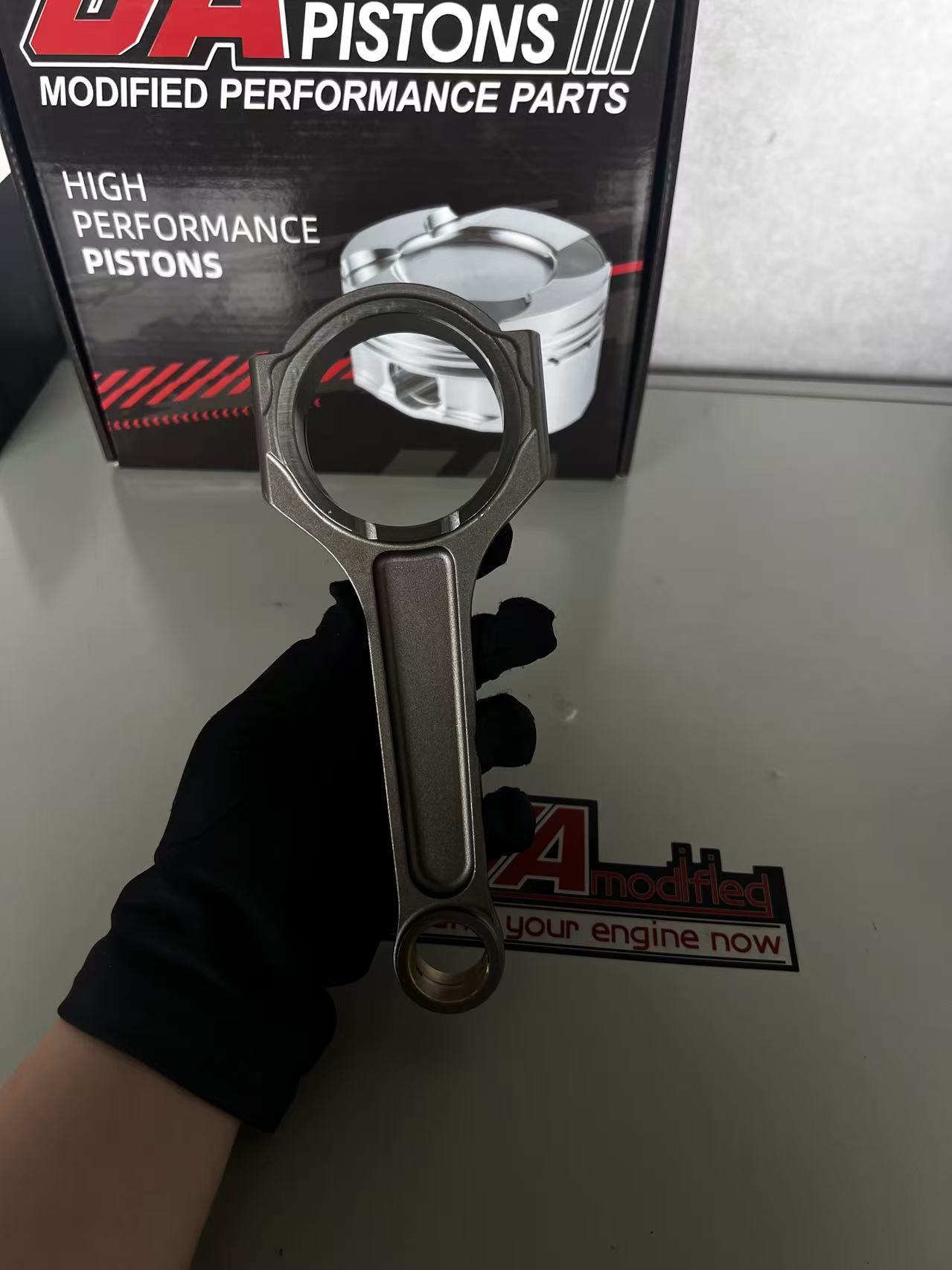
What the grades are.
4340 is a common alloy-steel route for high-performance forged connecting rods, and it is used in production rod lines from major makers. 300M is a modified 4340 route — a higher-strength direction of the same family, as described in alloy-maker material data. That is a description of the material route, not a promise about any specific finished rod.
Why "300M is stronger" needs a qualifier.
300M has high strength and toughness potential, but material potential depends on condition and heat treatment — a grade name alone does not fix a strength level, and material data from one application cannot be transplanted into a finished rod guarantee. The finished result also depends on:
- heat treatment and hardness control,
- beam section and small-/big-end structure,
- rod bolts, lubricant, torque and stretch,
- machining accuracy and surface condition,
- fatigue validation for the actual application.
Practical answers for customers.
- Is 300M stronger? 300M is a higher-strength-direction route; the finished rod still depends on design, heat treatment, bolts and validation.
- Is 4340 enough? Many high-performance applications use 4340 — judge by design, duty and inspection, not by the grade name alone.
- Is a 300M rod always better than 4340? That cannot be answered apart from the complete design.
Selection inputs, not guarantees.
Confirming a recommendation starts from application inputs — engine and displacement, target power and max rpm, boost, duty (street / drag / circuit / endurance), piston weight, stroke and fuel, bolt spec, and whether material / heat-treatment / dimensional and NDT reports are required. These are inputs, not a load rating derived from a grade name.
> Application matching should be confirmed before final specification. > > Sources: Carpenter Technology 300M alloy data (300M as modified 4340); Manley Performance connecting-rod catalogue (4340 rods; fatigue life depends on rpm, stroke, piston weight, boost); SCAT 4340 forged rods.